

Alcohol Beverage Production and the Jews: Stereotypes and Misconceptions
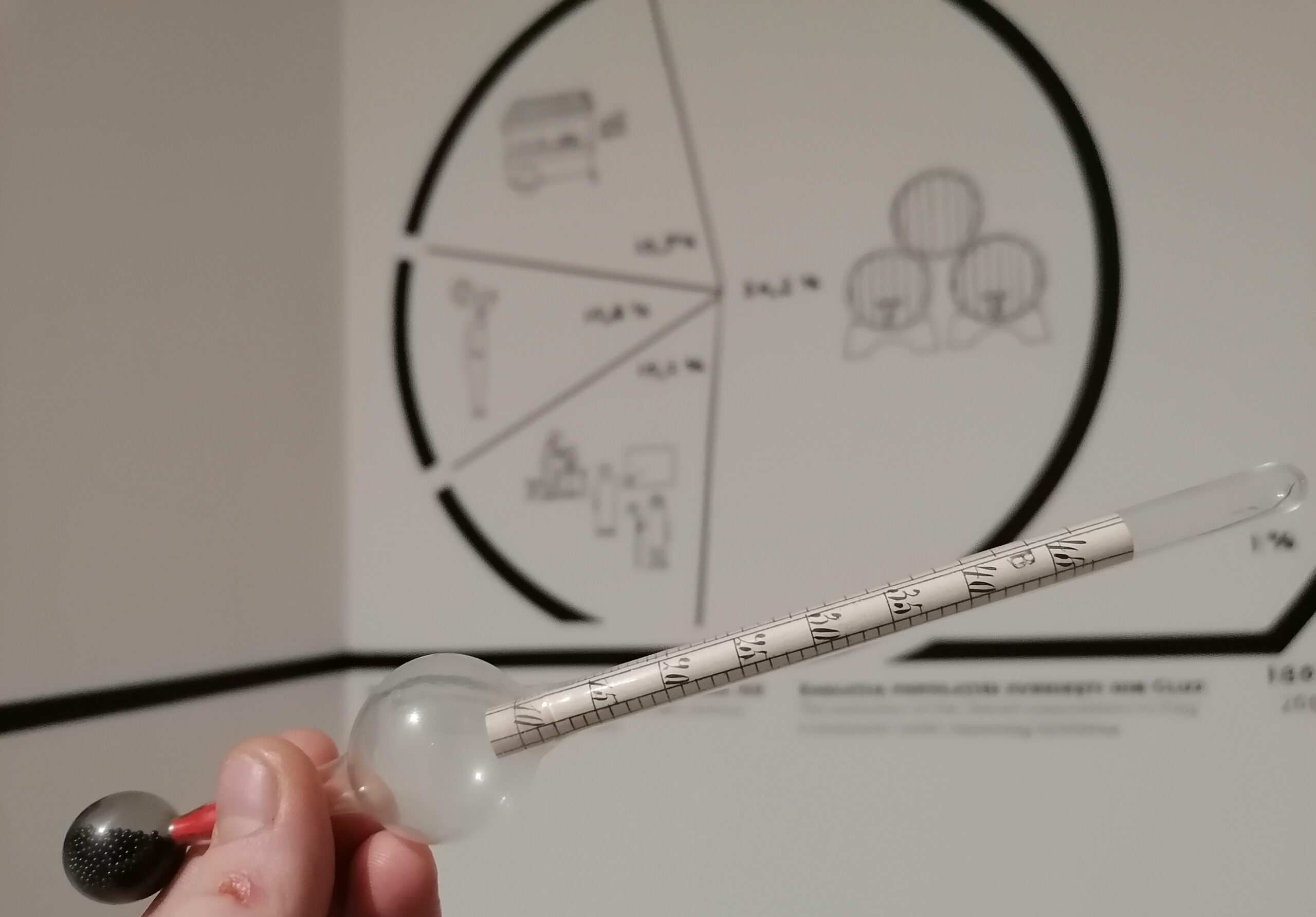
Recently, our museum’s collection was enriched with a fascinating new object: a 20th-century alcoholmeter that belonged to Pál Lusztig (one of the life stories you can listen to right here at the museum when you visit us). On this occasion, I aim to shed light in this article on the relationship between the Jews and the alcohol industry. Additionally, I outline how the transformation of this sector became intertwined with the “Jewish Question” of the era and with antisemitic value judgments.
The Alcoholmeter – Museum Artifact or Harbinger of an Industrial Sector
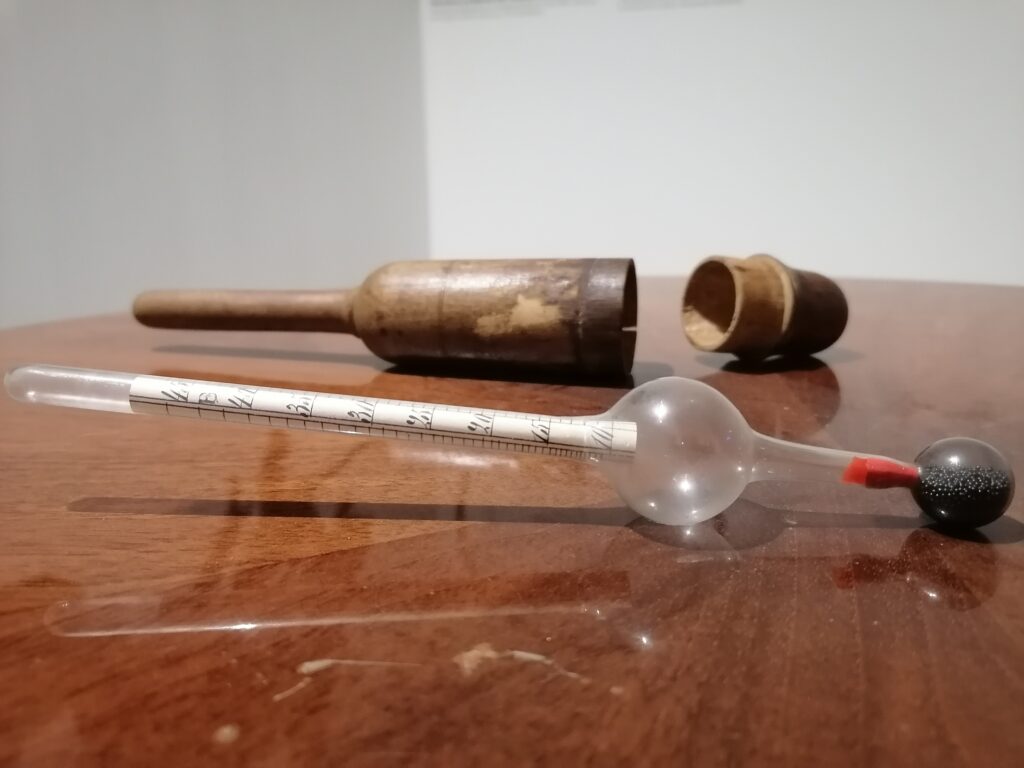
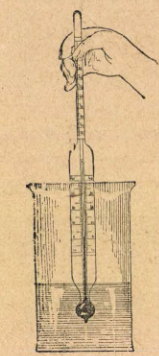
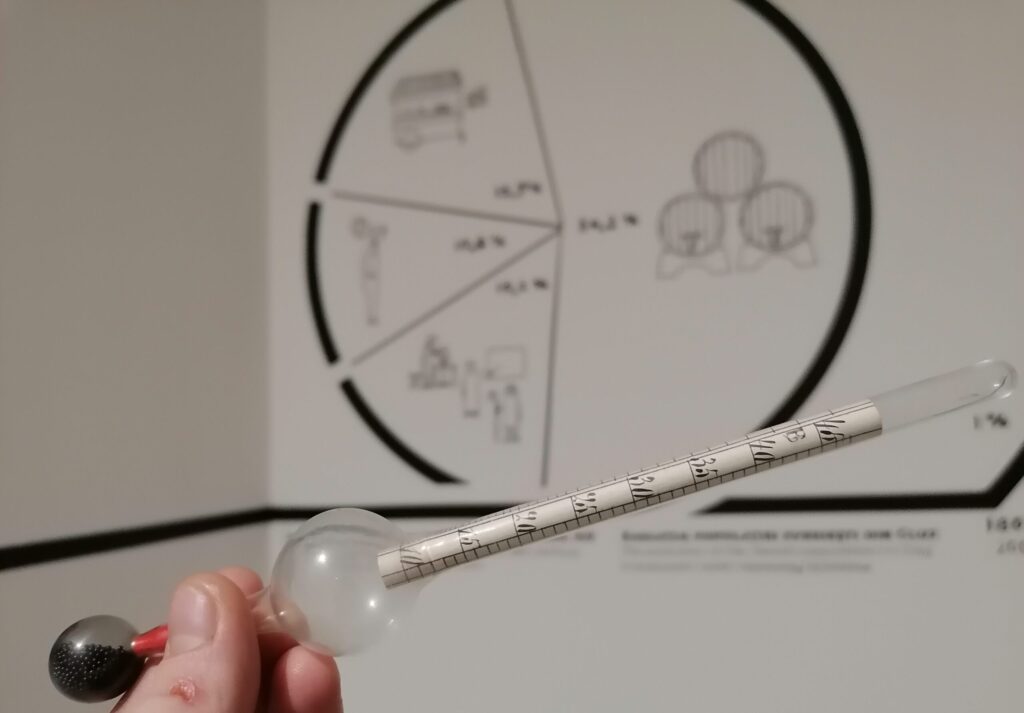
The alcoholmeter is a measuring instrument designed to determine the alcohol content of a liquid. Its operation relies on measuring liquid density: a floating tube fitted with an empirical scale sinks deeper into the analyzed liquid as its alcohol content increases. The measurement result is read directly from the instrument’s graduations.[1]
In terms of structure, the device consists of a graduated glass tube that floats freely in the liquid. Determining alcohol content was conducted at a standard temperature: alcoholmeters were typically calibrated at 15 °C, and measurements taken at different temperatures were recalculated to 15 °C. For this purpose, alcoholmeters were usually equipped with a built-in thermometer, allowing temperature to be factored in for precise readings.[2]
Below, drawing on specialized academic literature, I will present the economic and social context behind this object, as these factors give the artifact its true historical meaning.
Before the emergence of alcoholmeters at the end of the 18th century, alcohol content was tested using practical methods, such as observing the intensity and duration of foam created when shaking spirits in a bottle, or igniting spirits poured over gunpowder—where a sudden burst of flame indicated appropriate quality.[3]
What is important to realize is that in Hungary, during the second half of the 19th century, the free manorial monopoly was replaced by strict state regulation. This made both distilling and retailing alcoholic beverages contingent upon special permits, taxes, and production quotas. To enforce these measures effectively, accurate measurement of alcohol levels became indispensable, as tax rates and quality standards were adjusted directly according to the exact concentration and quantity of alcohol produced.[4]
Such regulation was introduced starting in the Neo-Absolutist era. The regulation of 1856 set the consumption tax on spirits based on raw material type, mash vessel capacity, and precise categories of alcohol strength.[5] The new alcohol law of 1862 likewise regulated taxation based on alcoholic strength.[6]
The Role of Jewish Communities in the Wine and Spirits Industry
In the second half of the 19th century, the wine and alcoholic beverage industry underwent significant technological and economic transformations in both Germany and Austria-Hungary. Viticulture increasingly separated from wine production and marketing, while new winemaking techniques, modern marketing, credit system developments, and shifting tariff and tax policies fundamentally redefined the sector. [7]
Jewish merchants had played a significant role in the wine trade since the Middle Ages, remaining key intermediaries between producers and the market. Following the Enlightenment, they became involved in growing numbers in the wine and spirits trade. Toward the end of the century, numerous wholesale enterprises were formed that consolidated the entire production chain under single management—from grape purchasing, processing, and storage, to final distribution. A notable example is the business of Lipót Zimmermann & Sons in Tokaj, which not only owned substantial vineyard acreage but also exported its wines to Budapest, Berlin, London, and New York.[8]
However, modernization also created significant economic tensions. Due to the phylloxera epidemic, the consolidation of global trade, and the rise of agricultural cooperatives, many traditional wine producers lost their former market positions. Numerous political figures explained these hardships through the activities of Jewish merchants, projecting onto them the roles of “middleman,” “speculative trader,” or even wine adulterator. In Austria and Germany, debates over artificial wine (Kunstwein) gradually merged with the Judenfrage—the political debate concerning the social and economic role of Jewish communities. Thus, the actual problem of wine adulteration was frequently weaponized for anti-Jewish propaganda, while the genuine root causes of economic crises and modernization anxieties were pushed to the background.[9]
Recent historical research, however, emphasizes that while Jewish merchants indeed played an important intermediary role in the Central European wine market, this alone does not account for the prejudices directed against them. The evolution of modern winemaking was driven primarily by technological innovations, the spread of enological science, market economy transformations, and expanding trade networks. Nevertheless, contemporary society often interpreted these complex economic processes through the lens of familiar antisemitic stereotypes, causing the modernization of the wine and alcohol industry to become tightly intertwined with political debates over the economic role of Jews.[10]
The Entanglement of Wine Adulteration and Antisemitic Discourse
Although wine adulteration was a known phenomenon since antiquity, by the late 19th century the debate no longer focused primarily on consumer health, but on separating natural wine from artificial wine and securing market positions for traditional producers. In this environment, economic changes gradually intertwined with the “Jewish Question,” and disputes over wine adulteration became increasingly laden with political and antisemitic undertones.[11]
The debate between “natural” and “artificial” wines grew increasingly fierce, evolving by the 1880s in Germany and Austria from a professional technical issue into a political one.[12] In the German and Austrian press, wine adulterators were depicted as the greatest enemies of honest winemakers, and the issue of artificial wine was gradually linked to the economic role of Jews.[13]
In Austria, a segment of wine producers joined antisemitic political movements as a result, attributing their economic difficulties to Jewish wine merchants and brokers. By the turn of the century, antisemitic propaganda actively targeted specific individuals and businesses. In the 1880s, Moritz Busch claimed that Germany’s reputation as a nation of wine falsifiers was caused by predominantly Jewish wine traders. In 1901, Emanuel Goldschmidt was convicted for selling artificial wine, while in the Durlacher case in Karlsruhe (1881), enological expert Dr. Nessler demonstrated that wines belonging to Moritz, Simon, and Leopold Durlacher contained significant proportions of non-grape alcohol alongside other additives. These high-profile cases were widely leveraged by the press and politicians to claim that wine adulteration was inherently linked to Jewish merchants, even though the phenomenon was not tied to ethnicity.[14]
Political attacks spread across the entire Monarchy. In 1901, twenty-one deputies in the Austrian parliament initiated a motion to ban artificial wines. In 1907, Austrian deputy Josef Herzog explicitly accused several Jewish merchants operating in Eisenstadt (Leopold Wolf), Tapolca (Adolf Lessner & Sons), and Mikulov / Nikolsburg (Teltscher & Glattauer) in parliament of enriching themselves at the expense of wine producers during natural disasters. Political rhetoric thus gradually equated wine adulteration with alleged Jewish economic influence, while the true causes of the viticultural crisis—modernization, market competition, and technological change—were sidelined. According to historians, by the turn of the century, the Kunstweinfrage (artificial wine question) and the Judenfrage (Jewish question) had become practically inseparable in Central European public discourse, with economic uncertainties frequently interpreted through antisemitic narratives.[15]
Conclusions
Returning to the alcoholmeter, we can see how complex social and economic history lies behind a single antique object. We can look at the alcoholmeter as an instrument illustrating technological progress, as an artifact that regulated the quality of alcohol production, or—given the context of wine adulteration cases and their antisemitic misinterpretations—as an object unfortunately tied to the history of prejudice.
FOOTNOTES
[1] Tolnai Új Világlexikona [Tolnai’s New World Encyclopedia], vol. 1, A–Bad (Budapest: Tolnai Nyomdai Műintézet és Kiadóvállalat Rt., 1926), 114.
[2] Ibidem.
[3] I. M. Harcsa, „„Csak az aljas köznép előtt kedves” italtól a Hungarikumig, avagy a pálinka becsülete” [From the Drink “Favored Only by the Common Rabble” to Hungarikum, or the Honor of Pálinka], Régiókutatás Szemle 3, no. 1 (2018): 31.
[4] Kinga Sebestyén, „Az égetettszesz-ipar fejlődése hazánkban” [The Development of the Spirits Industry in Our Country], Köztes-Európa 8, no. 1–2 (2016): 137–144.
[5] „162. szám. Kibocsátványa a pénzügyi ministeriumnak 1856 szeptember 4-ről [az égetett szeszes folyadékoknak a termelésnéli megadóztatása tárgyában]” [“No. 162. Decree of the Ministry of Finance of September 4, 1856 [Regarding the Taxation of Distilled Alcoholic Liquids at Production]”], Országos törvény- és kormánylap Erdély koronatartományra nézve / Landesgesetz und Regierungsblatt für das Kronland Siebenbürgen [National Law and Government Gazette for the Crownland of Transylvania], part 1, no. 14 (1856): 455–456.
[6] János Szulovszky, „Adatok a magyarországi szeszipar történetéhez (1850–1910)” [Data on the History of the Spirits Industry in Hungary (1850–1910)], Történeti Földrajzi Közlemények 5, no. 2 (2017): 138–139.
[7] Kevin D. Goldberg, „Reaping the Judenfrage: Jewish Wine Merchants in Central Europe before World War I,” Agricultural History 87, no. 2 (2013): 224–227.
[8] Ibidem, 228–236.
[9] Ibidem, 233–240.
[10] Ibidem, 240; Glenn Dynner, „‘A Jewish Drunk Is Hard to Find’: Jewish Drinking Practices and the Sobriety Stereotype in Eastern Europe,” The Jewish Quarterly Review 104, no. 1 (2014): 9–16.
[11] Goldberg, „Reaping the Judenfrage,” 224–227.
[12] Ibidem.
[13] Ibidem, 231–236.
[14] Ibidem, 237–240.
[15] Ibidem.
SOURCE
„162. szám. Kibocsátványa a pénzügyi ministeriumnak 1856 szeptember 4-ről [az égetett szeszes folyadékoknak a termelésnéli megadóztatása tárgyában]” [“No. 162. Decree of the Ministry of Finance of September 4, 1856 [Regarding the Taxation of Distilled Alcoholic Liquids at Production]”]. Országos törvény- és kormánylap Erdély koronatartományra nézve / Landesgesetz und Regierungsblatt für das Kronland Siebenbürgen [National Law and Government Gazette for the Crownland of Transylvania], part 1, no. 14 (1856): 455–456.
BIBLIOGRAPHY
Dynner, Glenn. „‘A Jewish Drunk Is Hard to Find’: Jewish Drinking Practices and the Sobriety Stereotype in Eastern Europe.” The Jewish Quarterly Review 104, no. 1 (2014): 9–23.
Goldberg, Kevin D. „Reaping the Judenfrage: Jewish Wine Merchants in Central Europe before World War I.” Agricultural History 87, no. 2 (2013): 224–245.
Harcsa, I. M. „„Csak az aljas köznép előtt kedves” italtól a Hungarikumig, avagy a pálinka becsülete” [From the Drink “Favored Only by the Common Rabble” to Hungarikum, or the Honor of Pálinka]. Régiókutatás Szemle 3, no. 1 (2018): 29–40.
Sebestyén, Kinga. „Az égetettszesz-ipar fejlődése hazánkban” [The Development of the Spirits Industry in Our Country]. Köztes-Európa 8, no. 1–2 (2016): 137–144.
Szulovszky, János. „Adatok a magyarországi szeszipar történetéhez (1850–1910)” [Data on the History of the Spirits Industry in Hungary (1850–1910)]. Történeti Földrajzi Közlemények 5, no. 2 (2017): 136–151.
Tolnai Új Világlexikona [Tolnai’s New World Encyclopedia]. Vol. 1, A–Bad. Budapest: Tolnai Nyomdai Műintézet és Kiadóvállalat Rt., 1926.